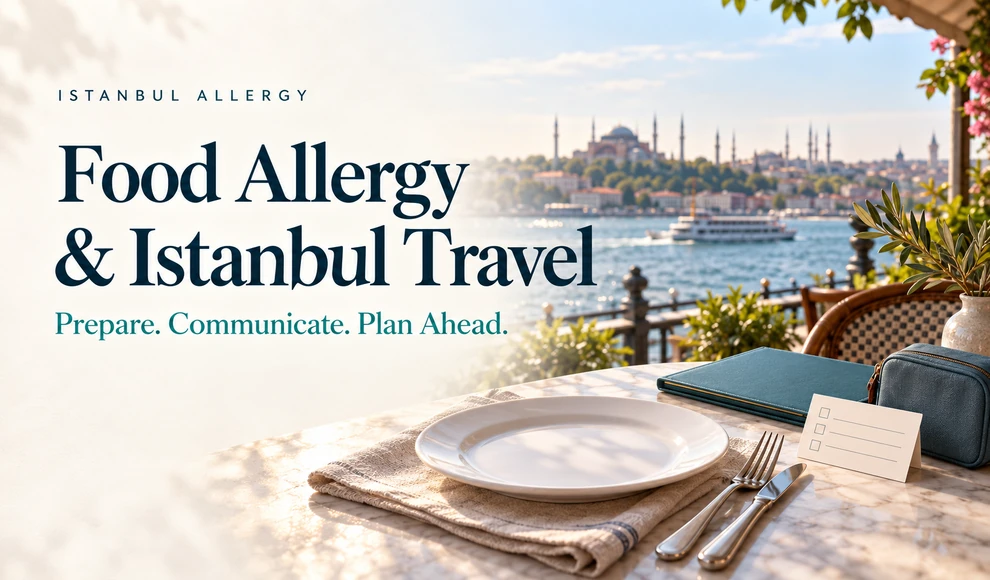
A food allergy does not automatically rule out visiting Istanbul, but the trip should be planned around the individual’s diagnosis, emergency needs and ability to communicate about food. Restaurant choice, ingredient checks, medicines and help during a reaction all matter. No destination, meal description or translation card can guarantee that an unexpected exposure will never occur.
Planning a food allergy consultation? Contact Istanbul Allergy on WhatsApp or call 0(212) 709 93 97. For an active medical emergency in Turkey, call 112.
The most useful preparation begins before departure. Review the current food allergy care plan, identify the exact foods that need avoidance and arrange enough prescribed medicine for the journey. Make a practical plan for meals during flights, transfers and the first evening after arrival. Being tired or hungry is a poor time to begin negotiating an unfamiliar menu without alternatives.
This guide focuses on travelling with an established or suspected food allergy, rather than recommending restaurants as universally safe. Istanbul Allergy can be contacted for planned consultation about diagnosis, earlier reactions or ongoing care. A routine appointment or online message is not an emergency service and should not replace local help if a serious reaction occurs during the visit.
Review the Diagnosis and Your Personal Needs Before Departure
A useful pre-travel review considers the confirmed allergens, previous reactions and the existing management plan. Explain any change in symptoms, uncertainty about a diagnosis or difficulty using prescribed treatment. If asthma or another relevant condition is present, discuss its control as part of preparation. The aim is a clear plan for the actual traveller, not a generic checklist copied from another patient.
Do not assume that travel requires a new broad food panel. Existing reports and a careful history may help identify what needs review. A positive test alone does not establish clinical allergy to every food listed, and unnecessary restrictions can make travel more difficult. Conversely, a previous concerning reaction should not be dismissed because an isolated test seems reassuring.
Clarify what to avoid, which foods are already tolerated and what to do after a possible exposure. Do not try an uncertain food at home or abroad simply to resolve the question before a holiday. If supervised assessment is appropriate, it should be planned separately with the responsible clinician. A departure date is not a reason to bypass clinical judgement.
Keep Emergency Medicines Accessible Throughout the Journey
If adrenaline auto-injectors are prescribed, review how many devices the individual should carry and make sure the supply covers the trip. Check expiry dates and device instructions with the treating team. Keep the medicines readily accessible in hand luggage or on the person, rather than relying on a checked bag that could be delayed or inaccessible when treatment is needed.
Carry the individual action plan and relevant prescription or medical documentation. Original packaging can help explain the medicine, but transport and border requirements should be checked for the actual route. Airline rules and security arrangements vary. Do not assume that a rule described for another country applies automatically to every airport, connection or destination.
Follow the product’s storage instructions and protect medicines from inappropriate heat, freezing or direct sunlight. A beach bag, parked vehicle or refrigerator may not provide suitable conditions. Ask the clinician or pharmacist if you are unsure. Do not rely on obtaining an identical device immediately after arrival or assume that an airline’s medical kit will replace the traveller’s own prescribed supply.
Agree What Your Companion Should Do
A travel companion can help with communication and emergency action, but only if responsibilities are understood. Explain the confirmed allergens, where the prescribed medicines are kept and how the action plan works. Relevant companions should know the device instructions and the signs that require emergency help. Do not assume that someone who has watched a previous mild reaction understands anaphylaxis.
For a child, agree who will communicate with restaurants and who will carry the emergency treatment. If caregivers separate during an activity, maintain appropriate access to the prescribed medicines. An adolescent should be included in planning rather than treated as a passive passenger. The goal is a workable routine that supports increasing independence without leaving important tasks undefined.
Keep emergency information available even if one phone battery runs out or mobile data is unavailable. A printed plan and an accessible accommodation address can help. Ask permission before sharing medical details more widely than necessary, but make sure the people responsible for immediate care have the information they need. Familiarity with the plan is more useful than simply packing documents that no one has read.
Speak to the Airline About Your Actual Needs
Contact the airline before travel to ask about its current allergy arrangements, meals and the practical handling of prescribed medicines. Policies differ, and an allergy note on a booking does not guarantee an allergen-free cabin. Explain the relevant needs and ask what can actually be arranged. Confirm the information for connecting flights as well as the main journey.
Do not assume that a special meal is suitable because its name sounds compatible with your allergy. Vegetarian, vegan, dairy-free and gluten-free descriptions answer different questions. Ask about the ingredients and limitations of the service, and consider appropriate food you can bring yourself, subject to the route’s security and import requirements. A backup option helps avoid pressure to accept an uncertain meal.
On boarding, communicate with the crew as appropriate and keep emergency treatment within reach. If symptoms occur, follow the prescribed action plan and alert the crew promptly. Do not wait to see whether a meal was supposed to be safe. Information gathered before departure supports planning, but the response to a reaction depends on symptoms and the individual emergency instructions.
Plan the Airport, Transfer and First Meal
Food planning should include the periods before and after the flight. Airport delays, a late transfer or a closed restaurant can leave fewer options than expected. Carry a suitable reserve of tolerated food where permitted and know how you will obtain a meal on arrival. This is particularly useful for children or travellers with several restrictions who may not be able to choose a substitute quickly.
Check the actual product label even when buying a familiar brand. Recipes and manufacturing arrangements can differ between countries or change over time. Do not treat a product as suitable solely because it was previously tolerated in another location. If you cannot establish the ingredients or interpret an important warning, use an alternative rather than guessing because the packaging looks familiar.
Before arrival, ask the accommodation about food arrangements and any practical preparation facilities. A promised kitchen, refrigerator or breakfast service needs confirmation for the specific booking. These facilities can support planning but do not establish that every utensil or surface is free of the relevant allergen. Review how food will be stored and prepared instead of assuming that self-catering removes all questions.
Choosing Restaurants: Assess Communication, Not Just Reviews
Online reviews can help identify places to contact, but they cannot certify the next meal. Menus, ingredients, staff and preparation can change. Contact a restaurant in advance where possible and explain the specific allergy. Ask whether someone can discuss both ingredients and cross-contact with the kitchen. A clear, informed response is more useful than a vague claim that everything can be made safe.
At the restaurant, repeat the information before ordering and make sure the person taking the order understands the request. If a booking note was made, do not assume it has reached every staff member. Ask who will check the proposed dish and how the kitchen will handle the relevant allergen. Keep the discussion specific rather than asking whether the restaurant is generally allergy-friendly.
If the team is uncertain, dismissive or unable to verify the ingredients and preparation, choose another option. A willingness to say that a dish cannot be prepared appropriately can be valuable information. Do not let politeness, a group celebration or a prepaid meal pressure you into eating something uncertain. Planning alternatives makes it easier to decline without turning the decision into a crisis.
Use a Personalised Turkish Allergy Card
A written card in Turkish can support spoken communication, especially when the allergy involves several ingredients or names that are easily confused. It should list the patient’s actual allergens and explain the need to avoid cross-contact. Use clear, accurate wording checked for the individual situation. An automatically translated phrase should not become the only basis for a high-stakes food decision.
A card is a communication aid, not proof that the kitchen can meet the request. Ask staff to read it and confirm that they have checked with the relevant person preparing the meal. Carry printed copies as well as a digital version. If the card contains broad statements that do not fit the diagnosis, revise it with appropriate support rather than creating unnecessary restrictions or ambiguity.
Useful opening phrases include “Gıda alerjim var” for “I have a food allergy” and “İçindekileri mutfakla kontrol eder misiniz?” for “Could you check the ingredients with the kitchen?” These phrases are only a starting point. They do not specify your allergen, explain every preparation issue or replace a properly personalised card and a clear conversation.
Recognise Important Allergen Names in Turkish
Learning the names relevant to your own allergy can make labels and conversations easier. Milk is “süt”, egg is “yumurta” and sesame is “susam”. Peanut is “yer fıstığı”, while pistachio is “Antep fıstığı”. That distinction matters: using only “fıstık” may leave the intended meaning unclear. Name the specific allergen rather than assuming that a general term will be understood consistently.
Other useful names include “fındık” for hazelnut, “ceviz” for walnut, “badem” for almond, “buğday” for wheat, “soya” for soy and “balık” for fish. This is not a complete dictionary of ingredient names or derivatives. If your allergy involves a food not listed here, obtain accurate wording for that food and the related ingredients identified in your individual plan.
Avoid treating a short vocabulary list as sufficient to approve a packaged product. Compound ingredients, sauces and manufacturing warnings may require more explanation. Wheat allergy and coeliac disease are different conditions, and a food described as gluten-free should not replace the questions needed for the actual diagnosis. Use the list to improve communication, then verify the complete information that matters for your own care.
Turkish Dishes: Ask About the Actual Recipe
A dish name is not a complete ingredient list. Turkish food varies between kitchens and recipes, so avoid assigning a universal safe or unsafe label to a whole category. For milk allergy, ask about butter, yoghurt, cream and other relevant dairy ingredients in the specific dish. For sesame allergy, ask about sesame seeds and tahini rather than focusing only on a visible topping.
Bakery products and desserts deserve careful ingredient and preparation questions where relevant to the patient’s allergy. Removing visible nuts or seeds does not establish that the remaining food is suitable. Sauces, fillings and garnishes can also introduce ingredients that are not obvious from a menu photograph. Ask what is actually used, including components prepared elsewhere and supplied to the kitchen.
Similarly, plain-looking rice, grilled foods or a salad should not be assumed suitable solely because they seem simple. Ask about cooking fats, marinades, dressings and shared preparation. This does not mean that all such foods must be avoided; it means the decision should follow reliable information about the particular meal. The patient’s confirmed allergy determines which ingredients and contact routes need attention.
Cross-Contact Is Different from Choosing a Dish Without the Ingredient
Cross-contact occurs when an allergen is unintentionally transferred to another food. Shared utensils, chopping boards, surfaces, cooking equipment or serving tools can be relevant. A dish can omit the allergen from its written recipe and still raise a preparation question. Ask the kitchen about the actual workflow rather than relying only on whether the ingredient appears in the dish name.
Examples worth discussing include a shared fryer, equipment used for several sauces or a knife moved between foods. Simply removing a topping or wiping away visible crumbs does not establish that the meal is suitable. Heat is not a dependable way to make a food allergen harmless. The service needs to consider appropriate cleaning and preparation rather than reassure the patient that cooking will solve every problem.
Keep the questions relevant to the individual allergy and the meal. A clear request might ask whether separate clean equipment and a suitable preparation area can be used. If staff cannot confirm the process, do not convert uncertainty into reassurance because the food looks unchanged. A restaurant conversation should establish what can actually be done, not merely whether someone is willing to promise zero risk.
Buffets, Bakeries and Shared Serving Areas
Shared serving areas can make cross-contact harder to assess because utensils and foods may be moved by many people. A buffet label can identify a recipe ingredient without describing everything that happens during service. Ask whether an appropriate portion can be prepared and served directly from the kitchen, if the venue can do so reliably. Do not assume that arriving early removes every preparation concern.
Bakeries and dessert counters may handle several relevant allergens in the same workspace. Explain the specific allergy before selecting an item and ask about both ingredients and handling. A product placed on a separate shelf may still have been made with shared equipment. Conversely, the appearance of a busy counter does not establish the composition of every item; reliable information remains the basis for the decision.
If the available answer is only a guess, choose a different meal or a verified alternative from your own supplies. Children and companions should understand why sampling an uncertain item is not a suitable test. This planning can reduce the pressure created by a hotel breakfast or an attractive display when the preparation details cannot be established.
Reading Packaged Food Labels in Turkey
Read the current label on the actual package, including the full ingredients and any relevant precautionary statements. Do not rely only on a front-of-pack claim, an old photograph or a familiar brand name. Packaging can differ between markets. If the product has an additional translated label, consider all the available information and ask for clarification when important details are inconsistent or unclear.
Türkiye’s Ministry of Agriculture and Forestry provides consumer information about allergen disclosure, including information for food served in catering settings. However, the existence of labelling requirements is not a guarantee against every mistake or cross-contact. Ask the business for the relevant information and interpret it in the context of the patient’s needs. This guide does not certify the compliance or suitability of any particular product or venue.
A vegan claim should not automatically be treated as proof that a product is suitable for milk or egg allergy, because ingredient choice and accidental contact are different questions. Likewise, do not assume that absence of a familiar warning answers every manufacturing concern. If your individual plan requires clarification beyond the label, contact the manufacturer or choose an alternative with sufficiently clear information.
Hotel Breakfasts, Self-Catering and Food Delivery
Tell the accommodation about the specific allergy before arrival and ask what its food service can realistically provide. A note on the reservation does not establish that the breakfast team has checked the kitchen process. Confirm the discussion with the relevant staff when you arrive. Ask about ingredients and preparation for each proposed option rather than treating a special breakfast label as a guarantee.
Self-catering can offer more control over ingredient selection, but shared utensils, appliances and surfaces still require attention. Check the preparation space and arrange suitable cleaning and equipment. Do not assume that a refrigerator is appropriate for storing every prescribed medicine; product instructions determine that separately. Keep food-planning and medicine-storage decisions clear rather than relying on one general room feature.
For delivery or takeaway, written order notes can be missed or misunderstood. Contact the restaurant where possible, explain the allergy and confirm the response before ordering. Check the delivered item and any labels, but appearance cannot confirm the absence of an allergen. If the response or delivery is uncertain, do not eat the meal simply because replacing it would be inconvenient.
Children, School-Age Travellers and Family Meals
Children benefit from a consistent routine about asking before eating, avoiding unplanned sharing and keeping prescribed treatment accessible. Explain the plan in language appropriate to the child’s age. Adults should not rely on a young child to manage every restaurant conversation. At the same time, include the child in learning the names and practices they will use as independence grows.
Plan snacks and meal timing so that hunger does not force hurried decisions. Ask about the ingredients of treats offered by guides, relatives or other guests, and make sure everyone supervising the child understands the restrictions. A food being offered kindly or eaten by other children does not establish that it is suitable. Agree how the family will handle uncertain food before such situations arise.
For adolescents travelling with friends or joining activities separately, discuss access to medicine and how companions will help. Embarrassment and the wish to fit in can affect disclosure, so make the plan practical rather than punitive. If multiple foods are excluded, seek appropriate nutritional advice. Do not add broad restrictions just because a new destination introduces unfamiliar names.
Recognising a Reaction and Getting Emergency Help
Anaphylaxis can develop rapidly and may involve breathing difficulty, throat or tongue swelling, a hoarse voice, faintness or collapse. A prominent rash may be absent. If anaphylaxis is suspected, follow the individual action plan and use prescribed adrenaline promptly according to the device instructions. Antihistamines do not replace adrenaline for anaphylaxis, and treatment should not wait for confirmation of the exact ingredient.
In Turkey, call 112 for emergency help. Give the location clearly, including the venue or accommodation name and address where possible. Follow the dispatcher’s instructions and seek emergency assessment even if symptoms improve after adrenaline. Avoid standing or walking; follow the action plan’s positioning advice. Further treatment and observation depend on clinical assessment, so this guide does not specify an individual dosing schedule.
Do not travel to a routine appointment or wait for a WhatsApp reply during a serious reaction. If the patient is in a restaurant, ask someone to help contact emergency services while the prescribed plan is followed. Save relevant packaging and information later if practical, but gathering evidence must never delay treatment. Immediate care takes priority over finding out exactly how exposure occurred.
After a Reaction: Review Before Continuing as Normal
After emergency treatment, follow the medical team’s advice about observation, medicines and further assessment. Do not assume that feeling better means the event requires no follow-up. Ask what the next steps are and whether any planned travel or activity needs reconsideration. Individual advice is particularly important before boarding a flight after a significant event.
When stable, record what was eaten, the timing and symptoms and the treatment given. Keep the discharge summary and any useful product information. Avoid turning an uncertain event into an unsupported label for every ingredient in the meal. A later allergy assessment can review the evidence and decide which investigation, if any, is appropriate.
Check that the prescribed emergency medicine supply and action plan remain adequate for the rest of the journey. Do not assume that replacement will be immediately available in a familiar form. Contact the responsible clinician or appropriate local service for help with the actual situation. A routine clinic consultation can support review after recovery but does not replace emergency care or discharge advice.
Insurance, Emergency Access and Practical Documents
Check your travel insurance arrangements for the established allergy and any pre-existing conditions. Ask the insurer about emergency care, required declarations and documentation rather than assuming that a general policy description covers the actual circumstances. This guide does not establish benefits or reimbursement. Keep the relevant contact details accessible alongside the emergency plan and identification.
Before going out, know how to describe where you are staying and how to call for emergency help. A map or saved address can help when internet access is unreliable. Medical identification may support communication if the patient cannot speak for themselves. These measures complement the prescribed plan; they do not replace timely treatment or access to emergency services.
A compact document set can include the current allergy summary, action plan, prescription details and any personalised language card. Use the clinic’s agreed process when sharing records for consultation. Avoid relying on one device or one companion to hold every essential item. The practical goal is to make the necessary information available when needed without carrying an unmanageable collection of unrelated reports.
Planning a Food Allergy Consultation in Istanbul
A planned appointment may be useful for reviewing previous reactions, clarifying a diagnosis or discussing an established management plan. Explain the patient’s age, main question and previous results when contacting Istanbul Allergy. Consultation with Prof. Dr. Ahmet Akçay and any additional specialist coordination should be arranged according to the individual concern. Do not assume that travel itself creates a need for every available test.
If a supervised food challenge or another procedure is being considered, confirm its indication and schedule separately. A routine appointment does not automatically reserve a procedure, and a short holiday may not fit every clinical requirement. Likewise, a request about oral immunotherapy needs an individual assessment of suitability and continuing care. It is not a way to obtain immediate permission to eat a suspected trigger during the trip.
An online consultation may help organise earlier reports and plan the next assessment, but it cannot perform testing or manage an acute reaction. Before departure from Istanbul, clarify any pending results and who will provide follow-up. Travel preparation works best when the everyday food plan, emergency response and clinical care remain connected, with each decision based on reliable information about the individual traveller.
Prepare the Food Plan and the Consultation Separately
Review the Plan Your Visit guide and, if clinical assessment is part of the trip, discuss the appropriate length of stay for allergy care. Restaurant communication and emergency preparation remain important whether or not you attend a consultation.
Planning a food allergy consultation? Contact Istanbul Allergy on WhatsApp or call 0(212) 709 93 97. For an active medical emergency in Turkey, call 112.
Frequently Asked Questions
Can I visit Istanbul if I have a food allergy?
A food allergy does not automatically rule out travel, but preparation should reflect the individual diagnosis and emergency plan. Arrange clear meal communication, prescribed medicines and access to help; no destination or venue can guarantee zero risk.
Do I need new allergy testing just because I am travelling?
Not automatically. Review the diagnosis, symptoms and existing reports with the responsible clinician where needed. Do not buy a broad panel solely because a trip is planned.
Should I carry my prescribed adrenaline on the plane?
Keep prescribed emergency treatment immediately accessible and carry an adequate supply as agreed with the clinician. Check storage instructions, expiry dates and the requirements for the actual travel route.
Does an airline special meal guarantee suitability?
No. Ask the airline about the actual ingredients and limitations and plan suitable alternatives where permitted. A dietary meal label does not establish that every allergy or cross-contact need is addressed.
Will a Turkish allergy card make a meal safe?
It can improve communication but cannot verify ingredients or kitchen practice. Use accurate personalised wording and ask staff to confirm what they can actually prepare.
Is peanut the same Turkish word as pistachio?
Be specific: peanut is yer fıstığı, while pistachio is Antep fıstığı. Using only fıstık can leave the intended meaning unclear.
Can I remove nuts or sesame from a dish and eat the rest?
Removing a visible topping does not establish that the remaining food is suitable. Ingredients and cross-contact need consideration; choose an appropriate verified alternative if the preparation cannot be clarified.
Is vegan food automatically suitable for milk or egg allergy?
No. A vegan description should not replace checking ingredients, relevant warnings and cross-contact arrangements for the individual allergy.
Can I rely on the same brand I buy at home?
Check the current label on the actual package. Ingredients or manufacturing arrangements can differ across markets or change over time.
What should I do if anaphylaxis is suspected?
Follow the individual action plan and use prescribed adrenaline promptly according to the device instructions. Call 112 in Turkey and obtain emergency assessment even if symptoms improve. Antihistamines do not replace adrenaline for anaphylaxis.
Can I use Istanbul Allergy WhatsApp during a severe reaction?
Do not wait for routine appointment messaging. Severe symptoms need emergency help immediately. Routine consultation can support assessment and follow-up after the patient is stable.
Can I arrange a food allergy consultation during my visit?
Contact Istanbul Allergy with the patient’s age, concern and earlier reports. Confirm the appointment scope and any proposed investigations before travel; a routine booking does not automatically include a supervised procedure.
Sources and Further Reading
These sources support general travel preparation and food allergy advice. They do not certify individual restaurants, products or airline arrangements. Personal emergency instructions and current provider information should guide the actual journey.
- CDC Yellow Book 2026: Severely allergic travellers.
- CDC: Allergies and travel.
- FARE: Dining out.
- FARE: Tips for international travel.
- AAAAI: Dining out with food allergies.
- FARE: Avoiding cross-contact.
- FARE: Food allergy chef cards.
- NHS: Anaphylaxis — recognition and emergency response.
- Türkiye Ministry of Agriculture and Forestry: Consumer questions about allergen information.
- Anaphylaxis UK: Travelling with serious allergies.
- Anaphylaxis UK: Eating out on holiday — allergy checklist.
- Allergy UK: Travelling safely with food allergy.